Run a user interview
An interview is a structured conversation Stunt Double runs with your users at a scale a manual research process can't match. This tutorial covers how to structure one, who to recruit, and how to read what comes back.
Structure sections and items
An interview is organized into sections, and each section holds a series of items. An item is either:
- A question, asked directly, useful for opinions, priorities, or recalling past experience.
- A task, where the participant is asked to attempt something (in your live product or a Figma prototype) and then reflect on it.
Mixing the two in a section works well: a task that puts the participant in a flow, followed by questions that surface what confused them or what they expected instead.
Recruit participants: actor personas or real people
Participants can be AI actor personas, real people, or a mix of both in the same round. Actor personas give you a fast, repeatable panel for testing a direction before you're ready to recruit, while real participants give you an authentic voice you can't get any other way. A common pattern is to run an actor panel first to catch obvious problems, then bring in real participants to validate what's left.
Launch a round
When the guide and participant list are ready, launch a round. Each round is a complete pass through the guide with every recruited participant. As you make product changes, launch another round against the same guide to see how perception shifts, rather than starting from scratch each time.
Read the report
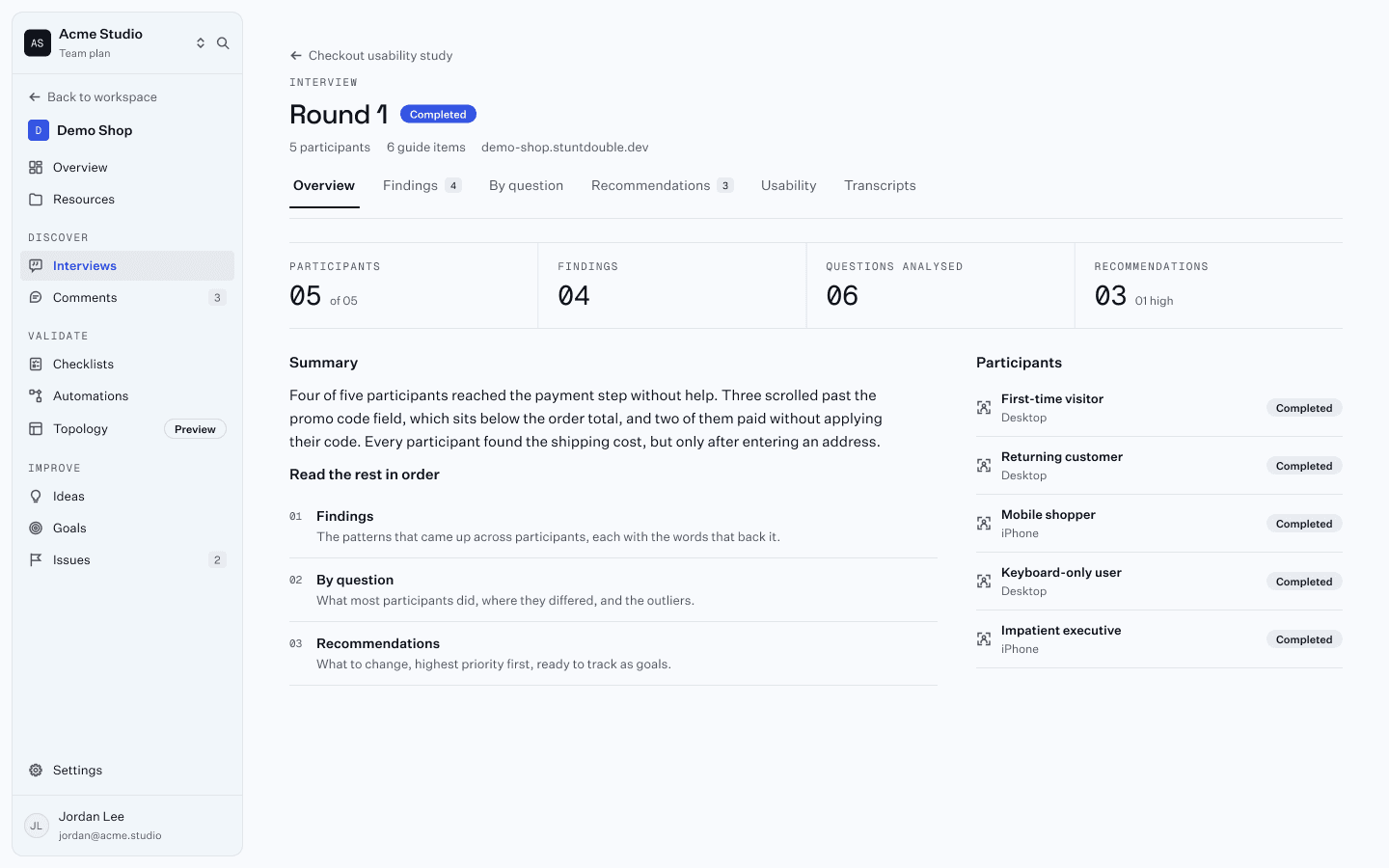
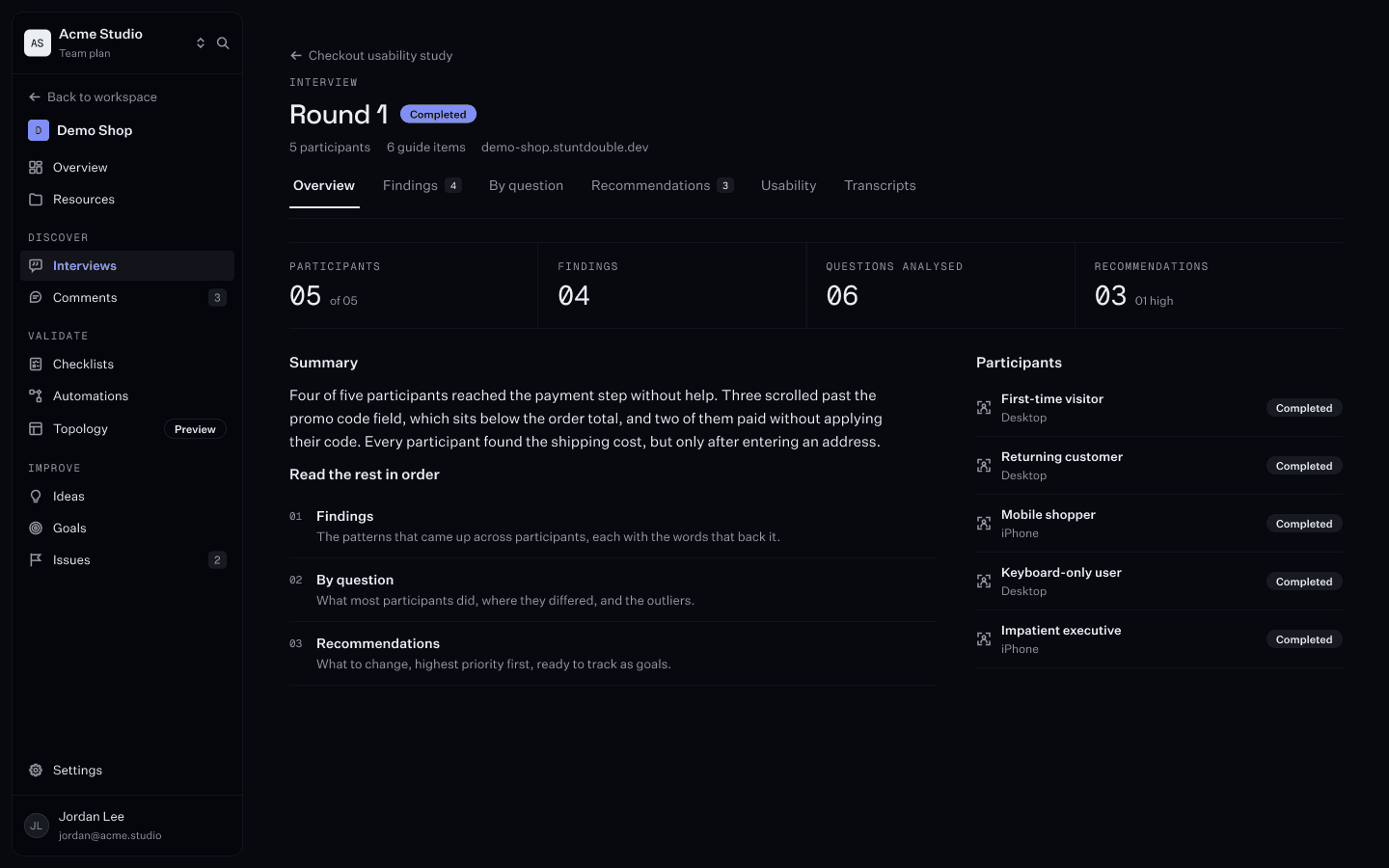
Every round produces a report with:
- Overview: the counts and a summary of what the round found.
- Findings: the patterns that came up across participants, each backed by evidence drawn straight from the interview.
- By question: what most participants did, where they differed, and the outliers.
- Recommendations: ranked by priority, ready to track as goals.
- Usability and Transcripts: the questionnaire scores and every participant's session in full.
Because every finding and recommendation is tied to evidence quotes, you can check a claim against what a participant actually said before acting on it.